 Story Circle
Interactive fiction
The main kinds of interactive fiction, a short history of the form, and the shapes a branching story can take.
The main fiction genres are fantasy, science fiction, dystopia, horror, thriller, mystery, romance, historical fiction, adventure, drama, comedy, young adult and experimental fiction. Each genre is defined by the experience it promises the reader — dread, a solvable puzzle, a relationship that arrives — and each splits into subgenres.
Last updated:
A genre is not a shelf. It is an unwritten contract between writer and reader: pick up a horror novel and you are owed dread, pick up a mystery and you are owed a puzzle that can be solved, pick up a romance and you are owed two people arriving at each other.
Below, every genre sits in one table with a definition, an example book and its subgenres. After that comes the part other lists skip: what each genre promises, what happens when that promise breaks, how the choice changes pace, viewpoint and chapter endings, and why several writers agreeing on one genre is a different job from one writer picking one.
The main fiction genres are fantasy, science fiction, dystopia, horror, thriller, mystery, romance, historical, adventure, drama, comedy, young adult and experimental; fan fiction is a separate form that can be written in any of them.
| Genre | Definition | Example book | Subgenres |
|---|---|---|---|
| Fantasy | Builds a world whose rules differ from ours but hold consistently; magic is not explained, but it works by rules. | J. R. R. Tolkien, The Lord of the Rings | Epic fantasy, urban fantasy, dark fantasy, fairy-tale fantasy |
| Science fiction | Changes one scientific or technological assumption and follows its consequences by cause and effect. | Frank Herbert, Dune | Space opera, cyberpunk, hard science fiction, time travel, alternate history |
| Dystopia | Portrays an oppressive or broken social order that makes sense from the inside. | George Orwell, Nineteen Eighty-Four | Totalitarian dystopia, post-apocalyptic, climate dystopia |
| Horror | Sets up a threat that can really land, to make the reader feel fear and dread. | Bram Stoker, Dracula | Gothic, supernatural, psychological, cosmic horror |
| Thriller | Keeps the reader waiting to see whether a close, concrete danger will happen; suspense comes from the wait. | Thomas Harris, The Silence of the Lambs | Psychological thriller, spy thriller, legal thriller, techno-thriller |
| Mystery / crime | Investigates a crime, usually a murder, as a puzzle the reader is invited to solve too. | Agatha Christie, Murder on the Orient Express | Whodunit, noir, cozy mystery, police procedural |
| Romance | Puts a relationship between two people at the center; the book ends where that relationship arrives. | Jane Austen, Pride and Prejudice | Contemporary romance, historical romance, romantic comedy, paranormal romance |
| Historical fiction | Tells a past period through characters who think like people of that period. | Leo Tolstoy, War and Peace | Historical mystery, historical romance, war novel, alternate history |
| Adventure | Sends the hero on a dangerous journey or mission; the interest comes from pace and obstacles overcome. | Robert Louis Stevenson, Treasure Island | Quest, survival, treasure hunt, sea adventure |
| Drama (literary / contemporary) | Nothing extraordinary happens; the story is the pressure inside ordinary life and the characters’ inner conflict. | Harper Lee, To Kill a Mockingbird | Family drama, psychological novel, social realism, coming-of-age |
| Comedy | Aims to make the reader laugh; the humor usually comes from a character’s flaw or a situation’s absurdity. | Jerome K. Jerome, Three Men in a Boat | Satire, parody, black comedy, absurdist humor |
| Young adult | A young protagonist meets something for the first time and makes the decision themselves. | Suzanne Collins, The Hunger Games | Coming-of-age, school story, YA fantasy, YA dystopia |
| Experimental | Deliberately breaks the form of the narrative — time, viewpoint, layout — and asks for an unusual kind of reading. | Italo Calvino, If on a Winter’s Night a Traveler | Metafiction, stream of consciousness, fragmented narrative, second-person narration |
| Fan fiction | Fiction a fan writes with the characters or world of an existing work; a form that can be written in any genre. | E. L. James, Fifty Shades of Grey (began as Twilight fan fiction) | Alternate universe (AU), crossover, one-shot, reader-insert |
The examples are well-known representatives of each genre, but most books touch more than one: The Hunger Games is both young adult and dystopia, The Silence of the Lambs both thriller and crime. Each book sits in the table under the genre whose promise it mainly keeps.
Science fiction has one of the largest families of subgenres: space opera puts scale first, cyberpunk the social cost of technology, hard science fiction scientific rigor. Fantasy and horror branch almost as widely.
Literary genres usually mean the broad forms of writing — fiction, nonfiction, poetry and drama — while fiction genres sort stories by the experience they promise: fantasy, mystery, romance and the rest.
The two classifications cut across each other: a mystery can be a novel or a short story, and a novel can be historical and romantic at once. Lists of “literary genres with examples” often mix both levels, which is why the same book can appear under “fiction” in one list and under “mystery” in another.
A related line people draw is “genre fiction” versus “literary fiction”. It is mostly about how openly a book speaks the language of expectation, not about how good the prose is. If you are writing your first piece, the structure itself is covered in how to write a story for beginners.
Genre does three jobs at once, and all three make the writing easier rather than harder.
It lets the reader find the book. Nobody goes looking for “a good book”. They want a specific thing tonight, and genre is the name of that thing.
It tells the reader what to pay attention to. A mystery reader treats every detail as evidence; the same detail in a contemporary novel is read as character. One sentence, two different jobs, depending on the contract.
It tells the writer what can be skipped. In science fiction you do not argue for the possibility of interstellar travel; in a mystery you do not justify at length how the body came to be found. A genre is the list of things the reader has already agreed to — and that list buys back pages.
A genre is the name of the promise a book makes: it tells the reader in advance how they will feel when they finish.
Which is why a genre can be broken — but only after you know which promise you made. A promise broken by accident reads as incompetence, not daring.
Every genre promises a particular experience, and what really defines it is how the reader feels when that promise is not kept. Here are the promises of the ten genres people confuse most, and the moment each one breaks.
The world runs on different rules, and those rules are not arbitrary. Dragons do not make a book fantasy; a rule that holds does.
One assumption is changed and its consequences are followed by cause and effect. The real subject is not the technology but what it does to people.
The threat is real and it can actually land. Horror comes not from the monster appearing but from the possibility that it will.
Something bad could happen on the next page and the reader knows it. Suspense is manufactured by waiting, not by surprise.
There is a solvable puzzle and the reader is invited to solve it. The detective is the reader’s representative, not their opponent.
A relationship sits at the center and the book ends where that relationship arrives. Everything else orbits that axis.
A past period told through people who think like that period. The era is not scenery; it is the limit the characters live inside.
Nothing extraordinary will happen. The interest comes from the pressure inside ordinary life: money, family, work, choice.
The protagonist meets something for the first time: first responsibility, first betrayal, first real decision. Age is not the marker; that firstness is.
A broken order that makes sense from the inside. How the power justifies itself matters more than what it does.
A subgenre is the same contract, narrowed: it does not widen the expectation, it sharpens it — a reader looking for noir rather than “a mystery” is asking for something far more specific.
Hybrids are not made by adding two genres together. They are made by choosing one as the contract and the other as material, because a book cannot make two promises at once. In a romantic mystery the reader waits for the solution first; in a mysterious romance, for the relationship. If the writer will not choose, the reader chooses — and usually chooses the one the book was not written to deliver.
By naming the promise you are breaking, making the break visible early and replacing what you removed; many of the best books in a genre break it, but deliberately.
“I will subvert the genre” is not a plan. “In this mystery the case will not be solved” is. If you cannot write the promise you are breaking in one sentence, you do not yet know what you are breaking.
Readers want to know whether the promise was broken on purpose. An early signal settles it: if the narrator distrusts their own conclusions in chapter two, the unsolved case in chapter twenty stops being a failure and becomes a different contract.
Take away an expectation and you owe the reader another one. If you withhold the solution, give them something more interesting than a solution — who did not want it found, and why. An unreplaced break is simply where the book stops.
A short test. If a reader finishes and thinks “that should not have happened”, the promise broke by accident. If they think “that was done to me deliberately”, it did not break — it was replaced. The difference is almost always made in the opening chapters.
Genre settles most small decisions in advance — pace, order of information, viewpoint, density of description, chapter endings and register — so the same event starts and ends in different places depending on the contract.
The one you read most: a genre’s contract is only known intuitively by someone who has seen many examples of it. Five steps make the choice concrete.
Count your last five books. Whatever genre most of them share is the contract you know best; writing in a genre you do not enjoy is playing a game whose rules you never learned.
Most stories begin as one scene rather than one genre. Write that scene, then ask what promise it makes to a reader. The answer usually names the genre for you. If you do not have a scene yet, start with how to come up with story ideas.
“This book promises the reader …”. Keep it somewhere you can see. That sentence is where you will settle every later argument with yourself about whether a scene belongs.
Genre is established on the first pages, not on the cover. A horror novel owes unease in its first chapter, a mystery owes a question worth answering. Readers infer genre from tone long before they read a label.
One question is enough: did this chapter advance the promise, or postpone it? Two postponements in a row and the book is drifting out of its genre — either go back, or change the promise on purpose.
With a written contract, not a label: what can happen, what cannot happen, and what the book promises the reader will feel.
For one writer, genre is a preference. For several writers it is an agreement. Tell three people “we are writing fantasy” and you get three different books: one imagines dragons and kingdoms, one imagines magic hidden in today’s city, one imagines a fable whose rules are never explained.
This is usually where shared books come apart. Chapter two does not keep chapter one’s promise; by chapter three nobody knows which promise they are meant to keep, so they make their own, and one book becomes three. The rest of the machinery is in the guide to collaborative writing.
In a shared book, genre is the one decision nobody can change alone. It needs a three-sentence contract, not a label.
What can happen, what cannot happen, and what the book promises the reader will feel. All three fit on one line each — and if they are not written down, every writer invents their own version.
How does this work in Story Circle? Story Circle is a mobile app where a book is written chapter by chapter by a community instead of a single author. The person who sets up a book does not only pick a genre: they write chapter one, define the characters and record the book’s writing rules. Whoever joins later learns the genre from a real chapter rather than a label — inheriting a tone, a pace and a promise already made.
When a book is set up, its genre comes from this list: fantasy, science fiction, fan fiction, adventure, thriller, crime, romance, horror, drama, comedy, historical, dystopia, young adult and experimental. There is also “One word”: books titled with a single word, where each writer adds what that word means to them as a separate path.
When the next chapter is open, the first person to start writing it has the time the book allows to finish it, and every submitted chapter passes automatic content review before it is published. In branching books several continuations can sit under one chapter, so two directions inside the same genre become two paths instead of an argument, and readers choose which one to follow. How to plan one is in how to write a branching story.
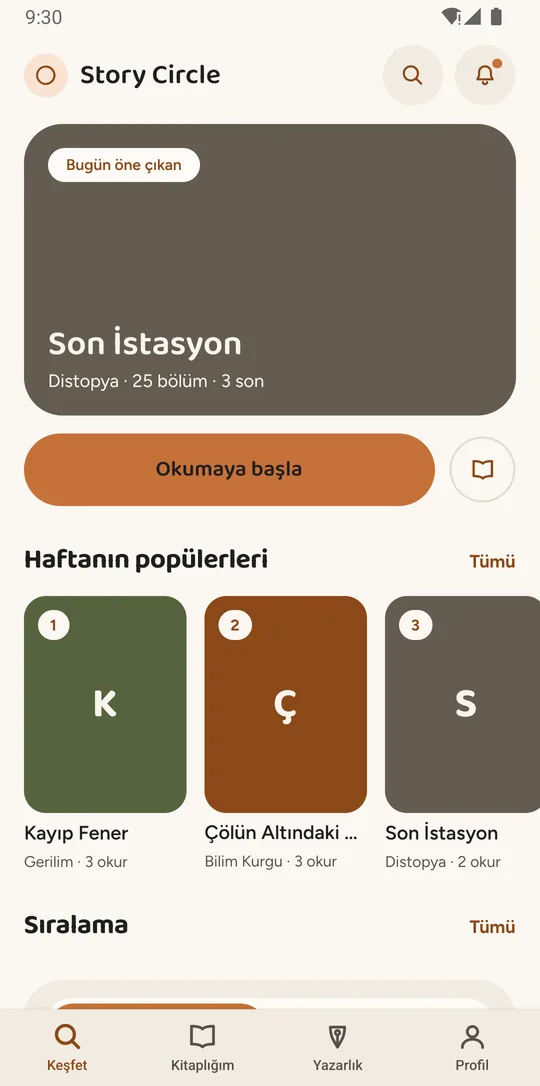
On the reading side, genre is how books are found: the Discover screen lists every book with its genre. Story Circle is currently in closed testing on Google Play; the public Android release is planned for November 1, 2026, with the interface in English and Turkish. The full writing cycle is explained in how Story Circle works.
There is no fixed number. Genre is not a scientific taxonomy but a shared language of expectation between readers and writers, so new genres appear as new expectations settle and old ones survive as subgenres inside larger ones. In practice about fourteen main genres are enough to describe what a book promises.
The difference is not spaceships versus dragons — it is where the explanation rests. Science fiction says “this could happen” and follows the consequences of one changed assumption by cause and effect. Fantasy says “in this world the rule is this”, and it never has to explain the rule, only stay consistent with it. The same event can appear in both; what changes is the kind of belief asked of the reader.
Yes, but one contract has to lead. In a hybrid, one genre makes the main promise and the other supplies material: in a romantic mystery the reader waits for the puzzle first and the relationship second. If the writer does not decide which one leads, the reader decides — usually wrongly.
It reduces the number of open decisions. Without a genre, every scene reopens the question of what kind of book this is, and the manuscript drifts. With a genre, that question is closed and only one remains: what happens in this scene. The real constraint appears when a writer tries to break a contract they never learned.
The one you read most. If the genre you want to write differs from the genre you actually read, write what you read: a contract is only known intuitively by someone who has seen many examples of it. Writing in a genre you do not enjoy is playing a game whose rules you never learned.
Two things. For readers it is how a book is found — books are listed with their genre on the Discover screen. For writers it is a shared contract: the person who sets up a book chooses the genre together with the first chapter, the characters and the writing rules, and everyone who writes later can see them on the book page.
The main kinds of interactive fiction, a short history of the form, and the shapes a branching story can take.
Where a branch earns its place, how to keep the tree small, writing the chapter where paths merge, and how many endings are enough.
What fan fiction is and is not, the vocabulary of the form, where copyright draws the line, and staying consistent in someone else’s world.