 Story Circle
How to come up with story ideas
Ways to generate story ideas instead of waiting for them, a test for whether an idea is a story, and how to cut it to one sentence.
To write a story, start with a character who wants something and an obstacle in the way. Sketch the beginning, middle and end in one sentence each, open the first scene where the trouble starts, build the middle from scenes that each change something, end on what it costs the character, then read the draft aloud and cut.
The seven steps below work the same for a class assignment, a first short story or a single chapter of somebody else’s book. Each step moves one example story forward, so you can see what the advice looks like on the page rather than just in theory.
Last updated:
Want, obstacle, a three-sentence plan, an opening scene, a middle, an ending and a revision pass: each step uses the answer to the one before it.
A story starts with someone who wants something, not with an idea. Make the want concrete enough that a reader could tell whether it has been achieved. “She wants to be happy” is a mood; “she wants her brother to answer the phone” is a want.
Example: Ada is the night clerk at a railway station that closed twelve years ago. She wants to know who is still paying its electricity bill.
The obstacle is the engine of the story. The best obstacle is rarely a wall; it is another person who wants something different, because a wall can be climbed once and a person keeps pushing back.
Example: The station manager, Tom, pays the bill himself, and he does not want anyone asking why.
Before you draft, write three sentences: what starts, what gets harder, what changes. They are the map you come back to when you get lost, and you are allowed to change the last one later.
Example: Beginning: Ada finds the bill. Middle: the closer she gets to the payer, the harder Tom pushes back. End: she learns why the lights stay on and has to decide whether to switch them off.
A first line has one job: make the second line necessary. Skip the weather, the alarm clock and the backstory, and begin at the moment the obstacle first shows itself.
Example: Weak: “It was a cold, quiet night at the station.” Stronger: “The station had been closed for twelve years, and someone was still paying the electricity bill.”
By the end of every scene the character has learned something, lost something or decided something. If nothing changes, cut the scene or turn it into a sentence of summary. In dialogue, let people avoid saying what they mean.
Example: “Who pays for the lights?” “Your tea’s getting cold.” Tom does not answer, and that silence tells Ada he is hiding something. In the next scene she finds the old timetable with one train still marked on it.
A strong ending shows whether the character got what they wanted and what it cost them. End on an action or a decision rather than a paragraph explaining what it all meant.
Example: Ada could switch the lights off and close the matter. It would cost Tom the last sign of the train his daughter never came back on. She leaves them on and signs the next bill herself.
When the draft is done, read it out loud. Every place your tongue trips is a place a reader will trip too. Delete the sentences nothing depends on and the paragraphs that explain a moment the scene already showed.
Example: “It was a quiet night, like every night at the station, and Ada was alone, as usual.” If the story loses nothing without it, it goes.
If step one is where you get stuck, the problem is usually the character, not the plot. The guide on how to create a character works through want, obstacle and contradiction one at a time.
Most short stories use three parts: the beginning sets up who wants what, the middle makes it harder to get, and the end shows what it cost.
| Part | Its job | In Ada’s story | Common slip |
|---|---|---|---|
| Beginning | Answers who, where and what they want. | The night shift, the bill that should not exist. | Explaining the character’s whole past first. |
| Middle | Raises the obstacle; each scene moves the character closer to the want or further from it. | Tom’s silence, the old timetable, the one train left on it. | Repeating the same obstacle scene after scene. |
| End | Shows what the want was worth and what it cost; the character is now someone slightly different. | Leaving the lights on and signing the bill herself. | A happy ending that costs nothing, or a moral. |
Beginning, middle and end describe the parts of the text; want, obstacle and cost describe what drives them. The middle is almost always the longest part, and a story speeds up noticeably when the beginning and the end are kept short.
Good dialogue is two people who want different things and do not say so directly; the information leaks out of the collision.
End on a change rather than a summary: the strongest chapter ending answers one question and opens another.
The chapter’s question is answered, and the answer raises a new one. Readers get a payoff and a reason to continue.
The character chooses, and you stop just before the consequences arrive.
The last line changes the picture the reader has been building. Two or three times a book is plenty.
After a tense chapter, a calm, concrete image. It lets readers breathe and gives the next chapter room to accelerate.
In a book where the next chapter is written by somebody else, your ending is the brief you hand them. End on a change and you have given them something to write; end on a summary and you have given them a blank page. When several continuations can follow one chapter, this matters even more — see how to write a branching story.
Most beginner mistakes live in the sentences written before the story starts and in the explanations written after it ends.
| Mistake | Instead | Why |
|---|---|---|
| Opening with the weather or waking up | Start where the obstacle first appears. | The first paragraph tells readers nothing has started yet. |
| A vague want | Pick an object, a fact or a person the reader can see. | Nobody can tell whether a mood has been achieved. |
| An obstacle that gives way at once | Give the obstacle to someone who wants something else. | A person escalates; an object is overcome once. |
| Backstory up front | Show the present first and let the past leak in. | Readers do not care about the past of a stranger. |
| Dialogue that delivers information | Make the lines about conflicting wants. | People explaining what they both know sound fake. |
| Dramatizing everything | Show what matters and summarize the rest. | Readers arrive at the key scene already tired. |
| Explaining the ending | Stop on the last action or decision. | The explanation takes the meaning away from the reader. |
Being stuck is usually missing information rather than missing inspiration: you do not yet know what changes by the end of the scene.
The different kinds of block, and a fix for each, are in the guide on how to overcome writer’s block. If the problem is earlier than that, start with how to come up with story ideas.
In Story Circle you write one chapter of a book somebody else started, not a whole story, and the seven steps above shrink to fit that one chapter.
The whole cycle is explained on how Story Circle works, and the wider question of sharing one book between several people on collaborative writing.
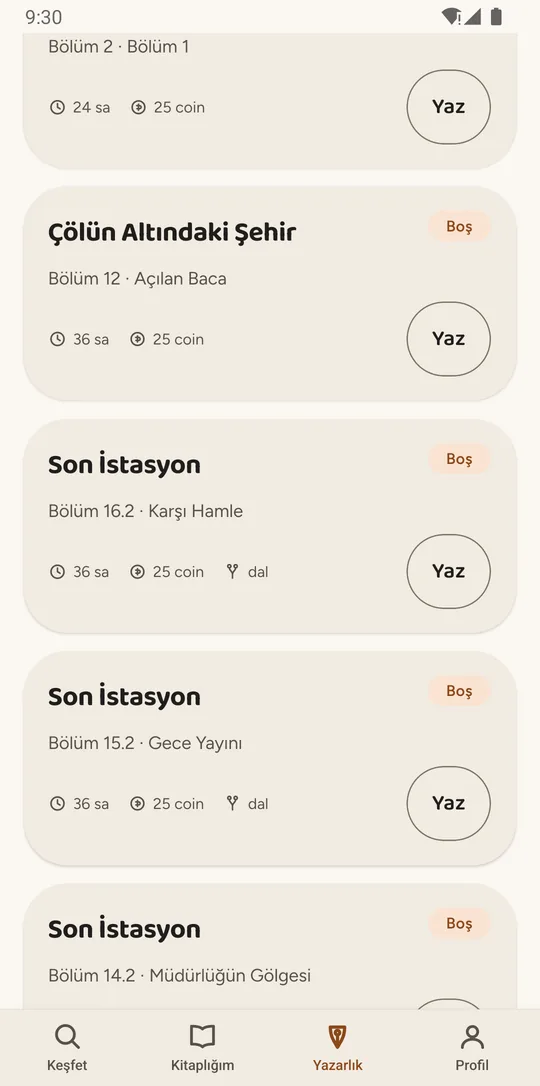
The easiest way to finish a story is to make it smaller: in Story Circle the unit of writing is a chapter, not a book.
Building one scene well is a far smaller job than planning a three-hundred-page novel — and the chapter you write becomes somebody else’s starting point.
Write one sentence naming a person, what they want and what is in the way. Then write the first scene in which they try to get it and fail. You do not need the title, the ending or the whole world yet; you need one person trying something.
Character, setting, plot, conflict and resolution; many teachers add theme as a sixth. In the steps on this page, the want and the obstacle are what create the conflict, and the cost in the ending is the resolution.
There is no fixed rule. For a class assignment, use the limit you were given; otherwise make it long enough to hold one real change and short enough to read in one sitting. Pieces under roughly a thousand words are usually called flash fiction. In Story Circle, chapter length is measured in characters and set by whoever set up the book; the preset ranges are 500–1,500, 1,500–4,000 and 4,000–10,000 characters.
Yes. The steps are the same at any age; younger writers can do the first three out loud before writing anything down. For a school story, the beginning, middle and end in step three usually matter most, because that is what the assignment is marked on.
Show whether the character got what they wanted and what it cost them, then stop. Do not add a paragraph explaining the meaning; readers remember an ending longer when they put the meaning together themselves.
Having someone read what you finish is the strongest reason to keep writing. Story Circle is a mobile app built for that: you start writing an open chapter of a book someone else began, the chapter is published once it passes an automatic content review, and somebody else writes what comes next.
In Story Circle, the first writer to start an open chapter writes it, and the chapter is published once it passes an automatic content review. The app is in closed testing on Google Play; the public Android release is on November 1, 2026. The interface is in English and Turkish.
Ways to generate story ideas instead of waiting for them, a test for whether an idea is a story, and how to cut it to one sentence.
Building a character from want, obstacle and contradiction, plus their voice, the decisions that define them and when they should change.
The different kinds of being stuck and a fix for each, what the standard tips really do, and when taking a break is the right call.