 Story Circle
Interactive fiction
The main kinds of interactive fiction, a short history of the form, and the shapes a branching story can take.
Fan fiction (fanfic) is a story written by a fan using the characters or world of an existing book, TV series, film or game, rather than by the work’s creator. It is usually shared free online, with readers who already know the source. The most common types are alternate universe (AU), crossover and one-shot stories.
Last updated:
This guide covers what the form is and is not, where it came from, the types it splits into, the vocabulary it invented, what separates a good example from a forgettable one, and the part everyone asks about — copyright — as honestly as it can be put.
Three things make a text fan fiction: a borrowed world, unborrowed sentences — the prose belongs to the writer — and a reader who knows the source. The third is the one people overlook, and it is the one that actually defines the form.
What distinguishes fan fiction is not the borrowed world but the shared knowledge: the reader already knows the character.
So fan fiction is not in the business of introducing. It is in the business of filling gaps — the year nobody wrote, the minor character, the question left open.
Fan fiction declares its source instead of hiding it, does not join the official canon, and is not merely practice — most confusion about the form comes from mixing up these three.
Plagiarism passes another person’s text off as your own. Fan fiction declares its source — a reader who knows the source is a condition of the form, not an accident.
Copying long passages from that source, though, is not fan fiction. It is plagiarism committed inside it.
What you write does not join the canon of the source, does not bind the rights holder and does not say “this is what happened”. It stands on its own as a separate text.
Fan fiction gets dismissed as a warm-up for “real” writing. But there are finished, long, carefully built works in the form; it is a tradition, not an apprenticeship.
Continuing someone else’s story is centuries old; modern fan fiction grew out of twentieth-century fan magazines and spread with the internet.
In 1614 a writer using the name Avellaneda published an unauthorized second volume of Don Quixote; Cervantes openly mocked it inside his own second volume a year later. The urge to continue someone else’s characters is as old as the book often called the first modern novel.
In the middle of the twentieth century, science fiction and television fans made their own amateur magazines: typed, duplicated and mailed to each other. From the late 1960s, Star Trek fanzines coined terms still in use today, such as “slash” and “Mary Sue”.
The internet took the cost of distribution to zero and brought feedback down to the same day. The habit of publishing chapter by chapter — writing the story alongside its readers — was established here.
FanFiction.net, launched in 1998, and later Archive of Our Own (AO3) brought huge collections of stories together and settled the tagging culture: which source, which characters, which genre, which warnings. Telling readers what they are about to read is a courtesy the form invented for itself.
With apps such as Wattpad, founded in 2006, fan fiction moved onto the phone: short chapters, serial publishing and comments that arrive immediately. Fan fiction about TV series, anime and K-pop is now largely written and read there.
Fan fiction is sorted by what it does to its source: alternate universes change the world, crossovers merge two works, and other types fill gaps, fix endings or put the reader inside the story.
| Type | What it does | Typical premise |
|---|---|---|
| Alternate universe (AU) | Keeps the characters, changes the world: another era, another job, another rule. | A “coffee shop AU”: the same cast, running a café today. |
| Canon divergence | Follows the source up to one point, changes a single event and rebuilds everything after it. | “What if that decision was never made?” |
| Crossover | Brings characters from two or more separate works into one story. | Two sets of world rules collide in the first scene. |
| Missing scene | Writes a scene the source skipped or only mentioned in passing. | The conversation the source sums up as “later, they talked”. |
| Fix-it | Undoes, or reworks, a canon event readers could not accept. | An aftermath where a character who died in canon survives. |
| Sequel and prequel | Tells what happens after the source ends, or before it begins. | The same cast ten years after the finale. |
| One-shot | A single, self-contained chapter with no continuation. The easiest way into the form. | One scene, one conversation, one moment. |
| Drabble | Traditionally a story of exactly 100 words. | A single glance, told in full. |
| Reader-insert (Y/N) | Puts the reader into the story as “you”; Y/N stands for “your name”. | “When Y/N opened the door…” |
| Self-insert | The writer places themselves, or a close stand-in, inside the story. | The author falls into the source’s world. |
| Real person fiction (RPF) | Features real celebrities — musicians, K-pop groups, actors — instead of fictional characters. | A story set on a band’s tour. |
| Songfic | Built around the moment or feeling a song describes. | The night a song is about, seen through the characters. |
The types overlap constantly — an AU can also be a crossover, a one-shot can also be a missing scene — which is why stories carry several tags at once.
Two of them need extra care. Real person fiction is about real people, so personality and privacy rights come into play on top of copyright; some platforms refuse it outright, and the ones that accept it have their own rules. Songfics that paste in a song’s lyrics raise a separate copyright question; writing what the song describes in your own sentences is both safer and better writing.
The best-known examples are novels that began as fan fiction and were later published as standalone books, and literary works that look at a classic from somewhere new.
What the four have in common: none of them copies its source’s sentences. They borrow characters and a world; the prose is the writer’s own. That is also the short answer to what fan fiction looks like in literature.
Fan fiction communities built their own vocabulary, and knowing it lets you read a story’s tags and know what you are getting.
Not quite: fan fiction is a way of writing rather than a genre, and a piece of fan fiction can be a romance, a horror story, a mystery or science fiction.
A genre is defined by the promise it makes — dread in horror, a solvable puzzle in a mystery. Fan fiction makes one of those promises and adds another on top: a world the reader already knows. That is why fan fiction is tagged twice, with its source and with its genre. What each genre promises is laid out in the list of fiction genres.
For most writers the reason is less enthusiasm than the writing itself: the world is ready, the readers are already there and feedback comes fast.
In fairness, there is one thing it does not teach: building a world and a cast from nothing. In fan fiction that work is already done. If that is the muscle you want, the guides on how to create a character and how to come up with story ideas exist for exactly that.
A reader who knows the character should be able to say “yes, they would do that” without saying “I knew that already” — good fan fiction lives between those two sentences, and five habits keep it there.
If a scene only works for a reader who remembers the source, then it is not the scene working — it is the memory. Good fan fiction is a story for someone who does not know the source, and an extra layer for someone who does. This is the form’s hardest and most distinguishing condition.
A character can change; what readers object to is change that costs nothing. If a silent man starts talking, we want to see what made him talk. Change without a visible price simply reads as out of character.
Whoever you add should do something in the story: carry a viewpoint, block someone, witness something. Turn the established cast into their satellites and you have taken away what the reader came for — they came to see that world.
In a ship, two people loving each other is not the event. The event is what the relationship costs them. Without that, a scene turns into two characters trading compliments.
If you are writing an alternate universe or a canon divergence, declare the contract: what changed, what stayed. Then keep to it. A half-altered world raises more questions than an unaltered one, and the reader spends the story waiting for answers instead of reading it.
There is no single yes or no: fan fiction uses characters and worlds someone else created, so it falls within copyright; free, credited, non-commercial work is in practice usually tolerated, while making money from it is a different matter entirely. The rules differ between countries and between cases, so what follows is a general shape, not an answer.
Ideas and expression are different things, but the distinction is less reassuring than it sounds. Nobody owns the idea of a story about explorers in space; the sentences that tell one are a work. And characters and fictional universes are treated as part of the work in most legal systems — so “I only used the character” is not a safe sentence.
The decisive line is between commercial use and free sharing. Work that earns nothing, names its source openly, does not substitute for the original and does not damage the rights holder’s market is in practice usually tolerated; the form has lived that way for decades. Selling, printing, paywalling, writing for donations and merchandising are a different activity entirely, tolerance is not extended to them, and nearly all of the trouble comes from there.
Copyright does not last forever, but its length varies by country. When protection ends, a work enters the public domain; in many countries that happens 70 years after the author’s death. Two details are easy to miss: the term is not the same everywhere, and even when a source is in the public domain, what a later adaptation added — a film, a series, a new translation — can still be protected on its own.
Rights holders differ enormously. Some creators openly welcome fan work, some openly forbid it, and most say nothing at all. The fact that fan work for a given source has been circulating for years does not mean permission was given.
Platform rules operate separately from law. A site or app may decline to publish something that would raise no legal problem, purely under its own content rules. Read the rules of wherever you are posting as a separate matter.
The text you wrote is yours. What is borrowed is the world; the sentences are your work. When those two get conflated, writers undervalue their own rights and readers misunderstand what they are reading.
Silence is not permission.
A rights holder saying nothing today does not mean they will say nothing tomorrow — and when a takedown request arrives, there is nothing to argue about.
The practical habits that follow are short and unambitious:
This page is not legal advice; it describes a general shape. The rules vary by country, by work and by situation. If you are considering anything commercial, or you have received a notice, consult a lawyer in your own country.
By answering four questions before you start: which canon, canon or fanon, what am I changing, and why would this character do this. In your own world, consistency is your memory; in someone else’s it is the reader’s — and theirs is better than yours.
When several writers share one world, those four answers have to be written down somewhere: which source, up to which point, which fanon is accepted, what has been changed. The rest of the machinery of writing together is in the guide to collaborative writing.
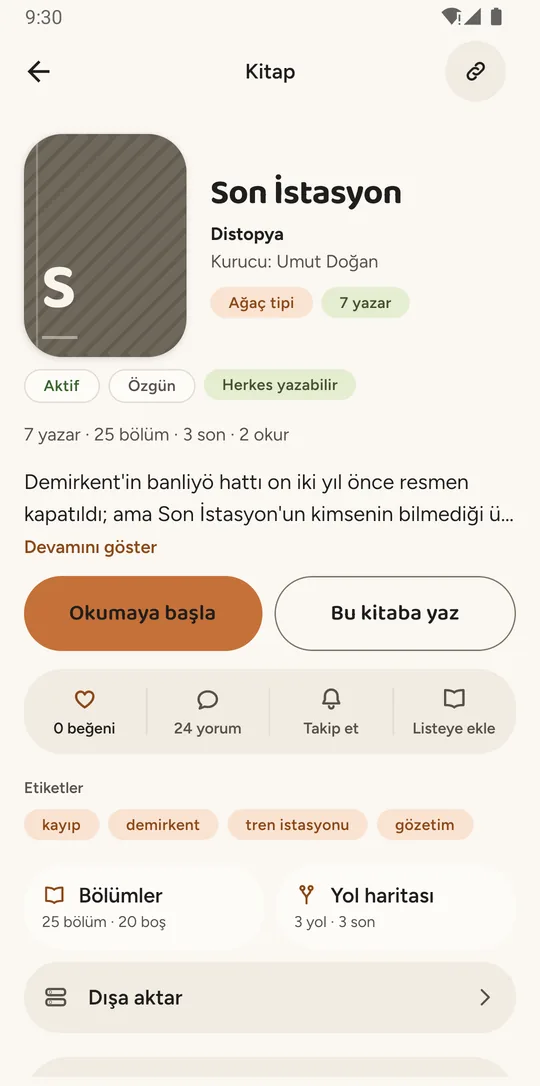
In Story Circle, fan fiction is a work type chosen when a book is set up, and the book cannot be set up without naming its source work. Story Circle is a mobile app where a book is written chapter by chapter by a community instead of a single author, and fan fiction there comes with a few concrete rules.
Story Circle is currently in closed testing on Google Play; the public Android release is planned for November 1, 2026. The app’s interface is available in English and Turkish — the screenshots on this site show the Turkish interface. The whole writing cycle is explained in how Story Circle works.
Fanfic is short for fan fiction: a story written by a fan with the characters or world of an existing book, series, film or game, rather than by the work’s creator. “Fic” on its own usually means the same thing.
Most K-pop fan fiction is real person fiction (RPF): stories about the members of real groups rather than about fictional characters. Because the subjects are real people, many platforms have separate rules for it, and some do not accept it at all.
This is the clearest line in the subject: selling, printing, putting it behind a paywall, writing it for donations or turning it into merchandise is a different activity from free sharing, and tolerance is not extended to it. Trying to earn from fan fiction without explicit permission from the rights holder is where almost all of the trouble comes from.
Plagiarism passes someone else’s text off as your own. Fan fiction does the opposite — it declares its source. The sentences are the writer’s own; what is borrowed is the world. Copying long passages from the source is not fan fiction; it is plagiarism committed inside fan fiction.
No. Changing canon is one of the form’s own modes — alternate universes and canon divergence do exactly that. The rule is not that you keep everything, but that you declare what you changed and then stay loyal to it.
No; original characters are an ordinary part of the form. What ruins it is the world rearranging itself around them. Give the character a job in the story — a viewpoint, an obstacle, a witness.
The work is the same work: building a scene, writing dialogue, keeping a character believable. Fan fiction teaches those fast, because readers and feedback are there from the first chapter. The one thing it does not train is building a world and a cast from nothing.
The main kinds of interactive fiction, a short history of the form, and the shapes a branching story can take.
The promise each fiction genre makes to the reader, subgenres and hybrids, and how choosing a genre changes what you write.
Where a branch earns its place, how to keep the tree small, writing the chapter where paths merge, and how many endings are enough.