 Story Circle
Interactive fiction: what it is, the main types and how to write it
Interactive fiction is a story whose path depends on the reader. At certain points the text hands the reader a decision — pick an option, type a command, follow a link — and the story continues differently depending on that choice, often to a different ending. Gamebooks, text adventures, Twine stories and branching books are all forms of it.
This guide covers what the term means (it has a broad and a narrow sense), the six main forms side by side, the tools people write it with, where to find it, and how Story Circle’s branching books — written by many authors rather than one — work.
Last updated:
What is interactive fiction?
Interactive fiction is fiction the reader acts on. The term is used in two senses, and a few neighboring names describe parts of the same idea:
- Broad sense
- Any story with reader choices: gamebooks, choice-based games, visual novels, branching video and branching books.
- Narrow sense
- In the interactive fiction community, “IF” often means parser games specifically: you type what you want to do and the program answers in prose.
- Choose your own adventure
- The name of a book series that began in 1979, now used for any story where the reader picks from a few options.
- Branching narrative
- The structure rather than the medium: a story that splits into several continuations, like a tree.
A branching story isn’t one story with detours. It’s a set of stories that share a beginning.
That is why branching is hard to write and easy to abandon: every choice you add multiplies what still has to be written.
What are the main types of interactive fiction?
Six forms cover almost everything: gamebooks, parser games, hypertext stories, choice-based games, interactive video and branching books. They differ in what the reader does and in how the story gets written.
| Form | What does the reader do? | How is it written? | Well-known examples |
|---|---|---|---|
| Gamebook (choose your own adventure) | Reads a numbered section, picks an option, and turns to that section. | Numbered sections and the links between them, on paper or with a tool. | Choose Your Own Adventure (from 1979), Fighting Fantasy (from 1982) |
| Parser game (text adventure) | Types commands such as “open the door” or “take the lamp”. | A system like Inform that describes a world through rules; close to programming. | Colossal Cave Adventure (mid-1970s), Zork |
| Hypertext story | Follows links inside the prose; the choice is a word, not a menu. | Twine: free and open source; passages joined by links, no code required. | Twine stories published on itch.io and similar sites |
| Choice-based game and visual novel | Taps options; choices often shift relationships tracked in the background. | Studios, game engines and scripting languages such as ink, ChoiceScript or Ren’Py. | Choices and Episode (mobile), Life is Strange (PC and console) |
| Interactive video | Picks one of two options on screen within a few seconds. | Every branch is filmed separately, so branches are few. | Black Mirror: Bandersnatch on Netflix (2018) |
| Branching book (Story Circle) | Chooses a continuation at the end of a chapter and sees where they are on a path map. | Each branch is plain prose written by a different author; no code, no separate tool. | Branching books in Story Circle |
Interactive fiction is a form, not a genre: it can be horror, mystery or romance. What each genre promises its reader is covered in our list of fiction genres.
Is interactive fiction a book or a game?
Both — it runs along a spectrum. At the book end, the story itself is the reward for a choice. At the game end, stats, inventory and scores add rules on top. The 1980s gamebooks sat in the middle: Fighting Fantasy had readers roll dice and keep an adventure sheet, while today’s choice-based games mostly track relationships in the background.
The difference changes the writer’s job. In a game, the effect of a choice can be stored in a variable and pay off three chapters later. In a book, the effect has to show in the text: if two paths don’t lead to genuinely different scenes, the reader hasn’t really chosen.
Choose-your-own-adventure books remain the most familiar entry point for younger readers, and most interactive story apps and games sit toward the game end. Story Circle sits firmly at the book end: no dice, no inventory, no points in the story — just a choice of which continuation to read, each one written by a person.
Which tools and engines are used to write interactive fiction?
Twine is the usual starting point because it needs no code. ink and ChoiceScript add light scripting for stats and conditions, Inform is built for parser games, and Ren’Py for visual novels.
| Tool | What you write | Best for | Coding needed? |
|---|---|---|---|
| Twine | Passages joined by links; publishes as a web page. | Short branching stories and first projects. | Not required; variables and macros are optional. |
| ink | inkle’s open-source scripting language for branching text. | Narrative inside games — inkle used it for 80 Days and Heaven’s Vault. | Light scripting. |
| ChoiceScript | Choice of Games’ language for multiple-choice games with stats. | Long choice-based novels where character stats matter. | Light scripting. |
| Inform 7 | A world and its rules, in sentences that read like English. | Parser games. | Yes — a programming language that looks like prose. |
| Ren’Py | Scripts combining text, images and sound. | Visual novels. | Python-based scripting. |
| Story Circle | Chapters as plain prose, in a mobile app. | Branching books written by many authors. | None — and no variables or stats either. |
The honest trade-off: engines give one author full control over variables and conditions, and the author writes every branch. Story Circle gives up variables entirely, and in exchange no single person has to write every branch.
Where can you find interactive fiction to read or play?
Most of it is free and a search away. Four long-standing places to start:
- IFDB, the Interactive Fiction Database — a catalog of games and stories with player reviews and ratings.
- The IF Archive — a long-running public archive of interactive fiction and the tools used to make it.
- IFComp — an annual interactive fiction competition held since 1995; entries are free to play.
- itch.io — hosts many Twine and other independent interactive stories, browsable by tag.
Branching books written by many authors are rarer, because most of these tools assume a single author. That gap is what Story Circle is built for.
How do you write interactive fiction?
Build one path from start to finish first, then fork only where the character would genuinely hesitate, and decide how many endings you’ll have before you start. In six steps:
Build the main path first
Branches need a trunk to leave. A story that scatters on the first page never gets deep anywhere.
Draw the choice from what the character wants
At a good choice point the reader asks “what would this person do?”, not “which option is cooler?”. Options should pull between what the character wants and what it will cost.
Cut fake choices
If two options meet again in the same scene a few paragraphs later with no trace left, that’s a pause, not a choice. Make one of them change something, or remove the choice.
Cap the branches up front
Fork where the story truly turns, not at every chapter. Know how many paths and endings you’re aiming for before you write.
Give every branch a real ending
A short branch that ends cleanly beats a long one that trails off. A path that leaves the reader hanging undoes the pleasure of choosing it.
Show the reader a map
Readers should see where they are, which paths they skipped and how many endings remain. A tree nobody can see is a tree nobody explores.
A ten-chapter book where every chapter can have two continuations reaches 512 separate endings when fully written — and needs 1,023 chapters.
That is where most single-author branching projects stop. The ways out: fork less often, merge paths back together, or share the writing among many authors.
Where a branch earns its place, how to write the chapter where paths merge, and how to plan endings are covered in depth in how to write a branching story.
How do branching books work in Story Circle?
When the person setting up a book chooses “Branching”, two different continuations can be written under the chapters where the story forks. Each continuation is written by a different author, and each reader chooses which one to follow.
Who keeps the tree in check?
The person who sets up the book decides three things before it goes live:
- Branch interval — whether the story forks at every chapter or, say, every four chapters.
- Maximum number of endings — once the limit is reached, no new forks open and the open paths run on a single line to their end. Left empty, there is no limit.
- Target chapter count — the length of a path. A chapter at that depth is the end of its path; a book that reaches its target can be extended later.
The branch interval and the maximum number of endings can’t be changed once the book is live — they are the skeleton of the tree.
On the reader’s side, the path map reduces the whole tree to four numbers: how long the main path is, how many alternative paths exist, how many endings you’ve found, and how many branches are waiting to be written. Your place is remembered together with the path you took.
The fourth number is where reading turns into writing: you see that a branch is still open, and the person who writes it could be you. Whoever starts an open branch first writes it, within the book’s writing time — one chapter, not the whole book. That mechanism is explained in our guide to collaborative writing.
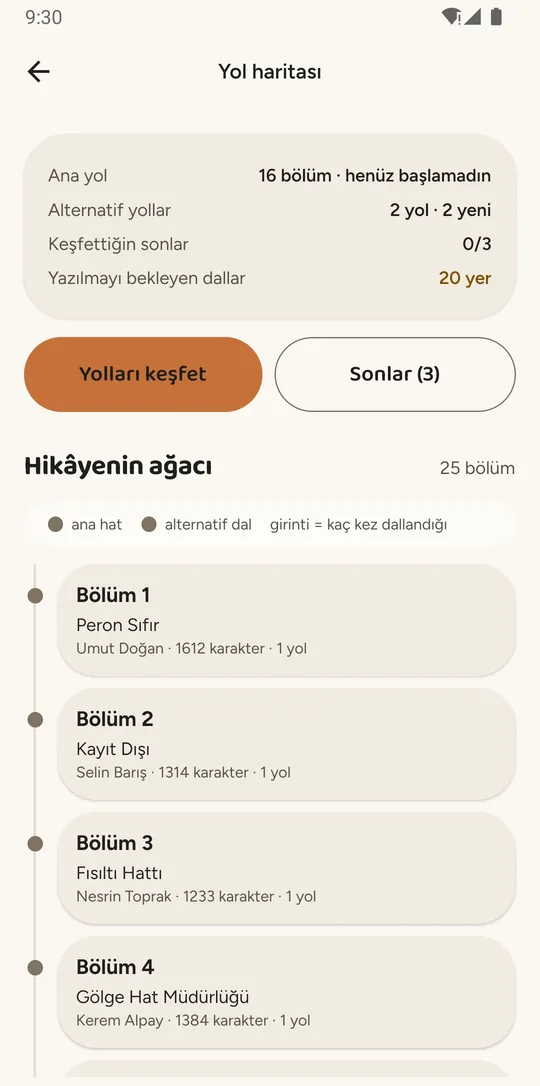
An example. Take a twelve-chapter book that forks every four chapters. The story splits at the end of chapters 4 and 8; every reader reads a twelve-chapter path, and the book has four endings. With every path written, the book is 28 chapters long. Had it forked at every chapter, it would need 4,095.
Story Circle isn’t a story engine: there are no variables, points or conditional text, and the only choice is which continuation to read. When you export a branching book as EPUB or PDF, the file is the path you chose, not the whole tree, and it says at the top which path it is. Everything else the book writing app does for readers and writers is on the features page, and the step-by-step cycle is on how Story Circle works.
Interactive fiction FAQ
Is interactive fiction the same as choose your own adventure?
Choose your own adventure is one form of interactive fiction: the reader picks from a short list of options and turns to a numbered section. The name comes from the book series that began in 1979. Interactive fiction is the wider category, which also covers parser games where you type commands, hypertext stories, visual novels and branching books.
Do you need to code to write interactive fiction?
No. In Twine you can build a branching story by writing passages and linking them, with variables only if you want them. Parser games written in Inform are closer to programming. In Story Circle there is no code at all: you write a branch as plain prose and the chapter tree is the structure.
How many endings should a branching story have?
There is no right number; the test is whether each ending reads as the result of a choice the reader made. Three well-built endings beat fifteen arbitrary ones. In Story Circle, the person who sets up a book can cap the number of endings in advance, and readers see on the path map how many of them they have found.
Can several people write one interactive story?
Yes, and branching is the structure that suits it best, because two writers who disagree can each write their own continuation. In Story Circle each branch is written by whoever starts it first, within the book’s writing time, and readers choose which path to follow.
Is Story Circle a game?
No. There are no dice, inventory or scores in the stories; the reader’s only action is choosing which continuation to read. In exchange, every branch is a chapter a real person wrote. If you want a gamebook with variables and conditional text, a tool like Twine, ink or ChoiceScript is a better fit.
Can I use Story Circle on iOS?
Not yet. Story Circle is an Android app, in closed testing on Google Play, with the public release planned for November 1, 2026. There is no iOS version. The app is available in English and Turkish.
Related pages
How to write a branching story
Where a branch earns its place, writing the merge chapter, and planning endings.
Collaborative writing
Shared docs, round-robin, voting and chapter slots compared — and how to write a book together, step by step.
Fiction genres
The promise each genre makes, and how choosing one shapes the writing.